Neousys PEXI-G360 Suite Lets Engineers Retrofit GPU Acceleration Without Replacing Fielded Systems
A new PCIe-to-PEXI adapter and external GPU enclosure gives existing rugged computers a path to up to 360W of NVIDIA SFF-Ready GPU power — without a full hardware swap.
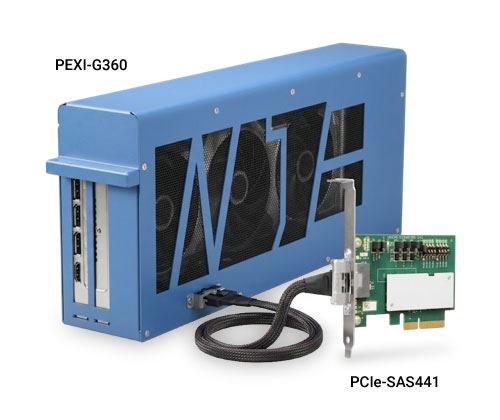
Neousys Technology has introduced the PEXI-G360 Suite, a rugged external GPU expansion platform built around a new interface the company calls PEXI (PCIe Expansion Interface). The suite allows embedded computers with a free PCIe slot to add up to 360W of NVIDIA SFF-Ready GPU acceleration externally, via a PCIe-to-PEXI adapter card (PCIe-SAS441) and a dedicated PEXI cable running at PCIe Gen4 x4 bandwidth.
For engineers and procurement teams managing deployed fleets of edge computers, this addresses a familiar problem: AI workloads keep growing, but swapping out qualified, already-installed industrial PCs just to add GPU horsepower is expensive and disruptive. The PEXI-G360 Suite instead separates the GPU into its own compact, DIN-rail or wall-mountable enclosure, connected externally to the host system. That means existing hardware — and the integration, certification and software work already done on it — stays in place while compute capability is extended.
Built for the Edge, Not the Data Centre
Unlike typical external GPU docks aimed at desktop or lab use, the PEXI-G360 Suite is designed for field conditions. It operates across a -25°C to 60°C range, accepts a wide 9–32V DC input suited to vehicle and robotic power systems, and includes onboard redrivers to preserve signal integrity over the extended PCIe link. Connector covers and an optional damping bracket address shock and vibration resistance, with MIL-STD-810H compliance cited for the bracket configuration. An independent power architecture and low standby draw round out a design clearly aimed at machine vision, AMR, and in-vehicle applications rather than static server rooms.
From a procurement standpoint, the distributed, two-box architecture is the more interesting engineering decision. Splitting GPU and host into separate enclosures simplifies placement inside control cabinets and space-constrained chassis — a common constraint in retrofit projects where panel space was never designed with a discrete GPU in mind.
Why It Matters in the Nordics
Nordic operators in maritime, defence and industrial automation frequently run long-life fielded systems — vessels, vehicles and production lines where hardware refresh cycles are measured in years, not product generations. As AI inference moves closer to the edge in machine vision and autonomous mobile robot applications, the ability to add GPU acceleration without re-qualifying an entire embedded platform has real operational and budgetary value, particularly where environmental ruggedness and long-term availability are already proven on the existing host.
The PEXI-G360 Suite positions GPU acceleration as a modular add-on rather than a forklift upgrade — a distinction that matters for anyone maintaining rugged systems over a multi-year lifecycle.